Sedan vs. SUV for Airport Travel From Marin County


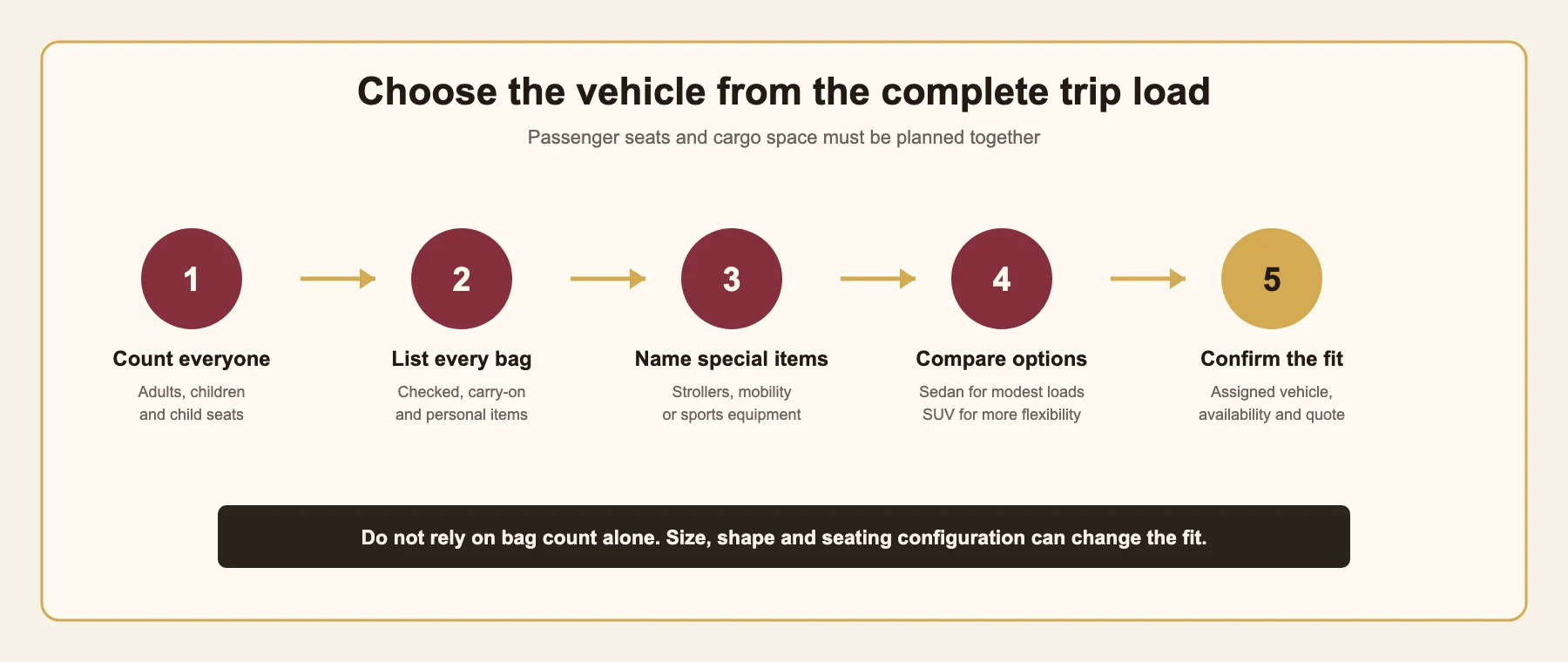
Choose an airport vehicle by considering passengers and belongings together. A sedan can suit many one-to-three-passenger trips with modest luggage. An SUV can provide more flexibility for a larger party or additional bags, but using more passenger seats can reduce usable cargo room. Share the complete load before booking so the assigned vehicle can be confirmed.
The right choice is not simply “sedan for one person” or “SUV for a family.” Bag dimensions, child seats, mobility equipment, sports gear and the amount of seating in use can change the answer. This guide gives Marin County travelers a practical way to compare the options before requesting an airport quote.
Quick comparison: sedan or SUV?
| Trip detail | Consider a sedan | Consider an SUV |
|---|---|---|
| Passengers | Usually one to three travelers | Larger party or a party needing more cabin flexibility |
| Standard luggage | A modest, clearly described load | More bags or a mix of checked and carry-on pieces |
| Unusual items | Request confirmation before assuming they fit | More flexible, but still requires dimensions and confirmation |
| Airport use | Individual, couple or executive travel | Family, group or luggage-heavy travel |
| Best next step | Send passenger count, every bag and any special item for vehicle-fit confirmation | |
This comparison is a planning tool, not a fit guarantee. Marin Gateway Limo confirms the available vehicle option for the specific trip before booking.
Start with the complete passenger count
Count every traveler, including children. If a child seat is required, include it in the request because it occupies seating space and may affect how the remaining passengers use the cabin. Also mention any passenger who needs extra boarding time, a mobility aid or another accommodation.
Marin Gateway Limo currently presents its luxury and executive sedans as options for up to three passengers. The Lincoln Aviator is presented for up to five passengers, and the full-size luxury SUV for up to six. These are service-planning limits, not an instruction to fill every passenger position while assuming the maximum luggage count will also fit.
A larger published passenger limit does not automatically mean the vehicle is appropriate for every group. Comfort preferences, the number of rows in use and the physical size of the belongings all matter.
Describe the luggage, not only the number of bags
“Four bags” can describe four compact carry-ons or four large checked suitcases. Those loads are not equivalent. For a useful recommendation, separate the belongings into categories:
- large checked suitcases;
- standard carry-on bags;
- backpacks or personal items;
- strollers or child-seat equipment;
- folding mobility devices;
- golf bags, skis, musical instruments or other long items;
- pet carriers or unusually shaped cases.
If an item is oversized, provide approximate dimensions or a photo when requested. The U.S. Department of Transportation advises travelers to check their airline’s current baggage limits because there is no single federal carry-on standard and rules can vary by airline and aircraft. The ground-transportation plan should use what you will actually bring, not what a generic airline example suggests.
Understand the passenger-space and cargo-space tradeoff
Three-row SUVs are flexible because seats can be used for passengers or folded to create additional cargo room. Those two uses compete with each other. Lincoln’s published Aviator specifications show different cargo volumes depending on whether space is measured behind the first, second or third row. That manufacturer information explains the design tradeoff, but it does not establish the passenger-and-bag combination for a chauffeured ride.
For example, a party that needs more rows for passengers may have less room available behind those seats. A smaller party may allow a different seating configuration. That is why passenger count and luggage should be reviewed together.
When a sedan is often the practical choice
A private sedan can be a straightforward choice for an individual, couple or small business party with a modest luggage load. The site currently lists the luxury and executive sedan categories for up to three passengers and up to two standard bags.
A sedan may fit when:
- the party has one to three travelers;
- the luggage is limited and accurately described;
- there is no oversized or long equipment;
- a child seat or mobility device does not create an unresolved space need;
- the travelers prefer a lower-profile private car for an airport or business trip.
Do not select a sedan only because the airline calls each piece a carry-on. Two rigid carry-ons can use space differently from two soft bags, and personal items still need somewhere to go.
When an SUV deserves consideration
An SUV can be useful when the trip has more passengers, more belongings or a combination that needs greater flexibility. Marin Gateway Limo currently lists the Lincoln Aviator for up to five passengers and up to four standard bags. The full-size luxury SUV is listed for up to six passengers and up to five standard bags.
Consider asking about an SUV when:
- the passenger count exceeds the sedan category;
- the party has several checked bags plus carry-ons;
- children, child seats or family equipment are part of the trip;
- the load includes a stroller, mobility device or special equipment;
- the group wants to stay together rather than divide into separate vehicles.
The published limits still require confirmation. A five-passenger Aviator trip with substantial luggage is a different fit problem from a two-passenger trip using the same vehicle.
Five trip details that can change the recommendation
1. Children and child seats
Include each child in the passenger count and identify the child-seat request. Do not assume a seat can be added without affecting the remaining cabin arrangement.
2. Mobility devices
Describe whether the device folds and provide dimensions when possible. Airport or airline wheelchair assistance is separate from the ground vehicle, so coordinate both parts of the journey where needed.
3. Sports and specialist equipment
Golf bags, skis and instruments can be longer than ordinary luggage. Name the item and quantity rather than adding them to a generic bag total.
4. International and extended trips
Longer trips often involve more checked luggage. Use the return-trip load too: purchases or equipment added during travel can change what must fit on the ride home.
5. Multiple pickup points
If passengers join at separate addresses, provide the final total and the belongings expected at each stop. Vehicle fit should be based on the maximum combined load, not only the first pickup.
A 30-second vehicle-fit checklist
- Count every adult and child.
- List large checked bags, carry-ons and personal items separately.
- Name any stroller, child seat, mobility device, sports item, instrument or pet carrier.
- Include the airport, flight details, pickup and destination.
- Ask the transportation provider to confirm the specific available vehicle option.
For the rest of the trip plan, review the SFO versus OAK guide for Marin County or the main Marin County airport transportation page.
What should you send with the quote request?
Send the airport, pickup and destination, travel date, requested 24-hour pickup time, flight number when relevant, total passengers and a complete luggage list. Add any child-seat, accessibility or special-item request. If the return load may differ, explain that too.
Marin Gateway Limo will review availability, vehicle options and pricing before the ride is booked. No payment is required to request a quote, and a vehicle category should not be treated as confirmed until the trip details have been reviewed.
Frequently asked questions
Is an SUV always better for airport transportation?
No. A sedan can be the practical option for a small party with modest luggage. An SUV becomes useful when passenger count, luggage or special items need additional flexibility.
Can five passengers and four bags always fit in a Lincoln Aviator?
Do not assume that every maximum passenger-and-bag combination will fit. Bag dimensions, the seating configuration and special items can change usable space. Share the complete load and obtain confirmation.
Should carry-on bags be included in the luggage count?
Yes. Include carry-ons, backpacks and personal items along with checked luggage. Every item must be stored safely in the vehicle.
What if we are traveling with golf bags or a stroller?
Name each special item and provide approximate dimensions if requested. These items can be longer or bulkier than standard luggage and may change the vehicle recommendation.
Can the vehicle choice be changed after requesting a quote?
Ask the company to review any change before the ride. Added passengers, luggage or stops can affect vehicle fit, availability and pricing.
Sources and review notes
- Lincoln: 2026 Aviator overview and cargo guidance
- Lincoln Media: Aviator technical specifications
- U.S. Department of Transportation: buying a ticket and baggage-policy guidance
- U.S. Department of Transportation: avoiding baggage problems
Vehicle images are representative. Published passenger and standard-bag guidance reflects the website’s current planning information; actual fit, availability, assigned vehicle and pricing are confirmed for the individual trip.